Showing posts with label The Sleeping Prince. Show all posts

Thursday, 9 March 2017

Book Review - The Sleeping Prince

I am powering through this series, aren't I? By the time you'll be reading this, I should be a good chuck of the way into the third and final book in the trilogy, The Scarecrow Queen.

But that's not the book we're talking about today.

The Sleeping Prince is the second book in the series and we follow, Errin, sister to a character we met in Sin Eater's Daughter. Errin lives with her mother who is suffering a misery illness. When the village has to be evacuated due to an fairy tale comes to life and begins war in the neighbouring country. But when events take a dark turn, Errin has to fled. But with her father dead, the mother ill and her brother missing, the only person she can turn to is Silas, who's face she has never seen...

But can she trust him?

This is an interestingly odd book. Not in a bad way, but this is a mix of being a first book in a series and the second. Bear with me while I explain why.

This is the second book in the trilogy. There is information and details from Sin Eater's Daughter is reference so reading the first book is important. This is the same with characters. This is a second book in the series and should be read as the second (I did try last year to read this without reading Sin Eater's Daughter and I struggled).

BUT... reading The Sleeping Prince does have elements of first book in a series. We have new characters, new situations and elements that feel very book one of a series. Plus, with this book timeline that overlap ever-so-slightly with Sin Eater's Daughter, you could read them side-by-side and you would be alright, in theory.

Although, I would say that if you are going to read this trilogy, read Sin Eater's Daughter first then Sleeping Prince.

This book I would say is split into two. Part one and part two. Part one is setting everything up. Character development, information dropping, setting things up. While the writing is dark and seductive, this is very slow. It is a bit of a struggle at times to push forward and I think, because of this, it took me longer to read. I don't mind reading slower pace - because this is a new character and we have to get to know them and their situation - and once I got to know Errin, I liked her and her attitude, but there were moments in part one I wished the book would pick up pace.

Part two is when the pace picked up and I whizzed through. This is the strongest part of the story because you go "This is why Melinda did this. This makes sense now. There's a plan!". Plus, like I said, I like pacer chapters. I like it when characters feel like they are doing something - and with Errin, it felt like she was more proactive in part two than in part one (but once you read part one, you understand why).

And because of part two and how it ended, I am excited/worried over Scarecrow Queen. Melinda has put her characters and story in position and now we're going to have to wait and see how she's going to wrap this up...

While I like Sin Eater's Daughter more, once it found it's footing, The Sleeping Prince is a worth sequel. Now, am excited/terrified over how Scarecrow Queen is going to end...

Thursday, 4 February 2016

Building the World of the Sin Eater

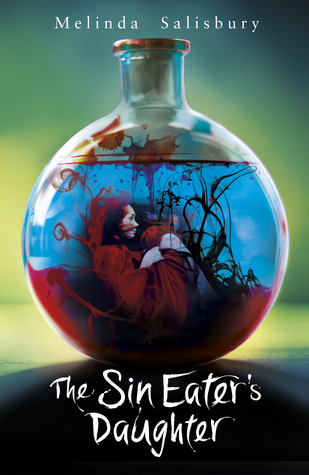
I am thrilled to welcome Melinda Salisbury onto the blog today! Melinda is the author of the books The Sin Eater's Daughter and her most recent novel, The Sleeping Prince, came out a few weeks ago.  After chatting to the lovely Faye asked if I wanted to be involved in a tour to celebrate The Sleeping Prince, I desperately wanted to. But I felt it would be unfair to without reading The Sin Eater's Daughter. But Faye and Melinda chatted and said I could have a tiny post before asking if there was anything I was curious over and wanted to know more about. I love world-building and how author can create worlds. Hence, this wonderful post. 

My thanks goes to Melinda (@AHintofMystery on Twitter) for having time to write this and to Faye (@FayeRogersUK) for asking if I wanted to do something to celebrate! Now, am going to hand it over to Melinda and we can talk world-building! 

“Lormere is fertile, but the altitude means a lot of the land is best used for livestock. We can grow our own potatoes, turnips, parsnips, rye and beans, but grain doesn’t thrive here. We have to import it from the north of Tregellan, where they have abundant farmland next to the river that separates Tregellan from Tallith. All of the fish and seafood for our table comes from Tregellan too, fished from the river or brought upstream by the fishermen who brave the Tallithi Sea.”

For me, the only way to build a world is from the ground up, quite literally. I start by thinking broadly about the outside setting as I imagine it; are there rivers, mountains, forests, etc. Once I have that picture in my mind of how the landscape looks, I start to get technical. 

This means thinking about the soil, which determines the plants and trees that grow there, and therefore the wildlife that feeds from them. And that affects the daily lives of the people who live there. The kind of produce the people can grow and farm decides what they eat, what they wear, even what they do for a living. You have to know what the seasons are like, what the climate is like, because that influences the kinds of clothes people need to wear, and the kinds of shelters they live in. 

Once you have all of the physical attributes of your world, you should explore the spiritual ones; what do the majority people of believe in, if anything? Have they always believed in it? This has a huge impact on how a country operates. Countries in our world that don’t separate faith and state are often (though not always) considered fundamentalist by the west. Where the governance is secular, the west sees it as more progressive, and usually democratic (state atheist – as opposed to state secularist - countries are often seen as fundamentalist and repressive too). 

Though a subjective perspective, this is a great starting point for figuring out the internal politics and economics of a place; even as far as its attitudes towards education, healthcare, science and citizens’ rights. 

For example, my first novel, The Sin Eater’s Daughter, exists in a place called Lormere, a country I completely made up, by a) cherry-picking bits from history and smashing them together, and b) finally putting my A* in GCSE Geography to good use (see, Mr Dale. I wasn’t just messing about with Rachael Cox at the back. I was learning too). 

In real terms Lormere is a very small country, around the size of Luxembourg. If it were on our planet it would be roughly where Sweden is, high above sea level, in a mountainous region. Winters (though we don’t see them in Sin Eater) are very harsh, summers comparatively mild and warm. The climate and landscape doesn’t lend itself too well to most types of arable farming, and limited pastoral; game, goats and sheep thrive, but cows and pigs don’t. 

Lormere, a country that doesn’t separate church from state, (and also practices the Cult of Personality) is a relatively poor country, with little import and export potential due to a lack of developing industries, and also opportunities. Financially it’s quite dependant on the tithes it receives from Tregellan as part of the peace treaty between them, as well as the taxes earned from citizens.

Tregellan, on the other hand, has thriving industry exporting grain, meat, fish and luxury goods to Lormere. It is a self-sufficient country. Because Tregellan isn’t as high above sea-level as Lormere, it has more arable farmland and pasture for livestock, and also has accessible coastline for fishing. The climate is close to our maritime climate, making it warmer and wetter than Lormere, though still cold in winter. Possibly most importantly, it’s also a democratic country, governed by an elected council, who took over after the dethroning (and executing) of the former monarchy. Power in Tregellan is handled at local level, with each town having a Justice who carries out district judgement in accordance with countrywide law, but with the ability to use their discretion and local knowledge. In just one hundred years it’s gone from being a country very like Lormere, to being progressive, liberal and very concerned with learning and development. In Lormere the Gods’ word is all, in Tregellan the religious are looked upon with scorn, even pity, by most citizens.

It might seem like an awful lot to have to figure out, especially when, as in The Sin Eater’s Daughter, you see very little of the external world, but in terms of writing The Sleeping Prince, and book three, it’s been invaluable to know the terrain of the world I’m working in. The contrasts and differences between the two countries are very important in terms of how they both respond to the threat of the Sleeping Prince, and the ultimate outcome of the trilogy. 


But that’s very much another story, for another time.